Government Destroying Environment in Assam and Northeast in the Name of Development
Journalists, Environmental Scientists, Social and Political Activists Express Deep Concern
Corporate Houses Increasing Control Over Water, Forests, and Land
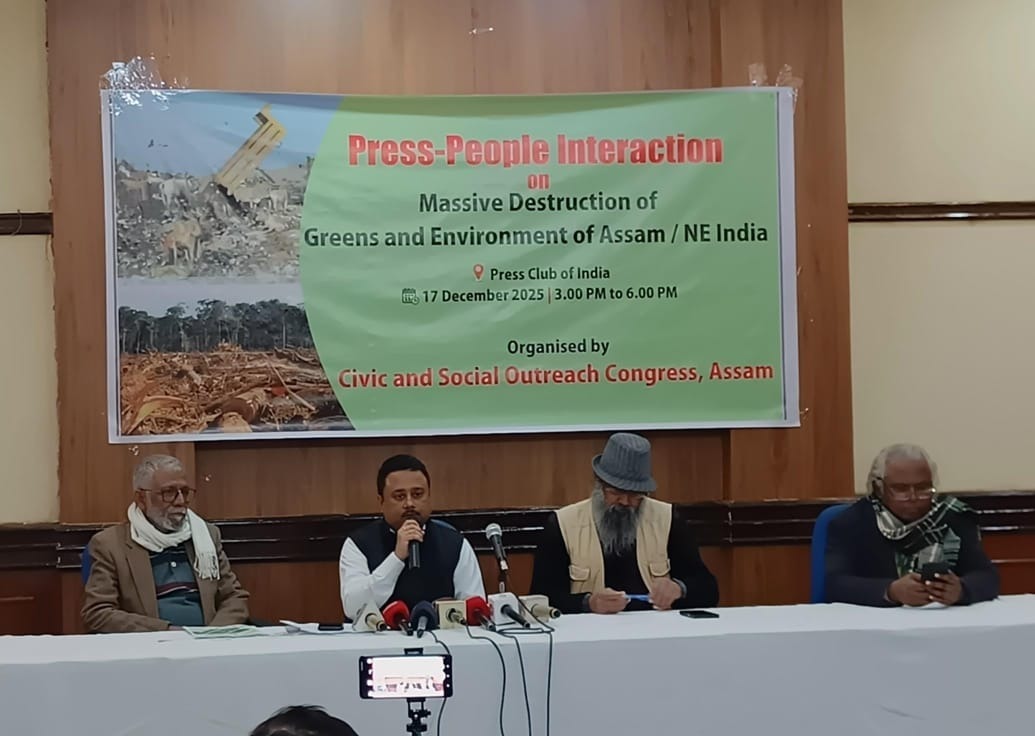
New Delhi: A public dialogue was held at the Press Club of India in Delhi on the issue of environmental destruction being carried out by the government in Assam and the Northeast. Bandip Dutta, President of the Civic and Social Outreach Congress, Assam, spoke in detail on this matter.
He stated that we are all well aware that the entire world is grappling with a deep crisis of global warming, which is manifesting in various aspects of climate change. We are facing this serious problem as a result of environmental destruction caused by capitalist and corporate powers. For example, the Amazon rainforest—the world’s largest, known as the ‘lungs of the Earth’ and providing 20% of the world’s oxygen—is now being recognized as a significant contributor to global warming. In this dialogue program, we aim to draw the attention of the country’s people to the major environmental problems currently being faced by the people of Assam, which serves as the main corridor of the Northeast region.
The current BJP-led government in Assam has launched an assault on the state’s environment in the interests of big businessmen like Adani and Ambani, the Chief Minister, and his ministerial colleagues. On one hand, the natural resources of verdant Assam—covered in rivers, mountains, and forests—have been looted; on the other, thoughtless constructions in the name of so-called development have turned Assam into a state deeply affected by natural oxygen crises and global warming.
In Assam, millions of trees have been felled for various construction projects, particularly the development of National Highways (NH). Over the past four years (2020-2024), approximately 94,000 trees were cut down solely for national highways, while thousands more were felled for flyovers in Guwahati. The state’s natural greenery is gradually being destroyed.
For highway expansion (NH37) and flyovers (such as Shraddhanjali, Dispur), more than 3,000 trees were cut in three years. Similarly, over 2,500 trees were felled for the expansion of NH-37 (from Vashistha to Jalukbari). During the same period, more than 4.20 lakh trees were cut for national highway development in the region.
As a result, the capital Guwahati has become a ‘heat hole’ (heat island). Massive carbon emissions have occurred, making the city unlivable and severely increasing pollution.
The government is cutting down trees and forests, leading to large-scale destruction of the environment and natural beauty. A citizens’ movement has arisen against the felling of decades-old trees on the banks of historic Dighalipukhuri in Guwahati. However, the BJP government led by Himanta Biswa Sarma cut down the trees along the lake the day after Jubin Garg’s death and arrested the protesters.
This reveals the true character of a government that claims to plant lakhs of saplings every year on World Environment Day. On the other hand, the Geological Survey of India estimates vast reserves in Assam: 18.89 million tons of iron ore in Goalpara and Dhubri districts, and limestone, bauxite, silicon, coal, and oil in Karbi Anglong, Dima Hasao, Golaghat, Nagaon, Cachar, Subansiri, Sivasagar, etc. The government has evicted people in the name of encroachment in these specified districts and areas, handing over 55,000 bighas of land for free to corporate groups like Adani and Ambani. The main issue is the looting of Assam’s vast natural resources. In other words, extracting these mineral resources would require digging up half of Assam’s land. As a result, environmental destruction will turn Assam into a slaughterhouse for human resources and a playground for corporate loot.
The current government has allocated thousands of bighas of land to corporate groups. This step will undoubtedly create a major environmental imbalance in the state. For this very purpose, the Assam State Zoo has also been handed over to Ambani. The zoo’s animals were overnight transferred to Ambani’s zoo in Gujarat. These are among the many reasons why citizens are taking to the streets to protect the zoo.
Bandip Dutta called upon all social organizations and civil society to cooperate in protecting Assam’s environment. This is extremely important because environmental destruction poses a serious threat to biodiversity as well.
Addressing the dialogue, Suresh Nautiyal, founder of Green Party India and environmental activist, spoke in detail about the global impact of environmental destruction in the name of development and emphasized moving towards sustainable development.
Meanwhile, Mitran Ranjan from the Right to Forum said that environmental destruction directly affects the poor, and displacement deprives children of education. Bhupendra Shandilya from Mobile Creches stated that floods in the Northeast most severely impact children’s education, health, and nutrition.
The editor of Green Patrika said on environmental destruction that the issue must now be made a mass concern. Raising questions on the corporate-government nexus and the judicial system, he stated that these institutions have spared no effort in poisoning the air.
Expert Rizwan Raza from Northeast states emphatically said that the current central government and its double-engine governments have a single agenda: to sell off the country’s resources to their crony corporates as quickly as possible. He urged the formation of a common platform for all Northeast provinces to deliberate on environmental issues.
Priyanshu, who researches environmental issues and works in an environmental lab at IIT, said that we must strike a better balance between development and the environment, and continuously work on alternative plans.
Journalist Himmat Singh, who moderated the dialogue, emphasized building a large public network on environmental issues, redefining the so-called definition of development,