How to Turn Defeat into Victory: The Edifice of Success Built on the Foundation of Failures
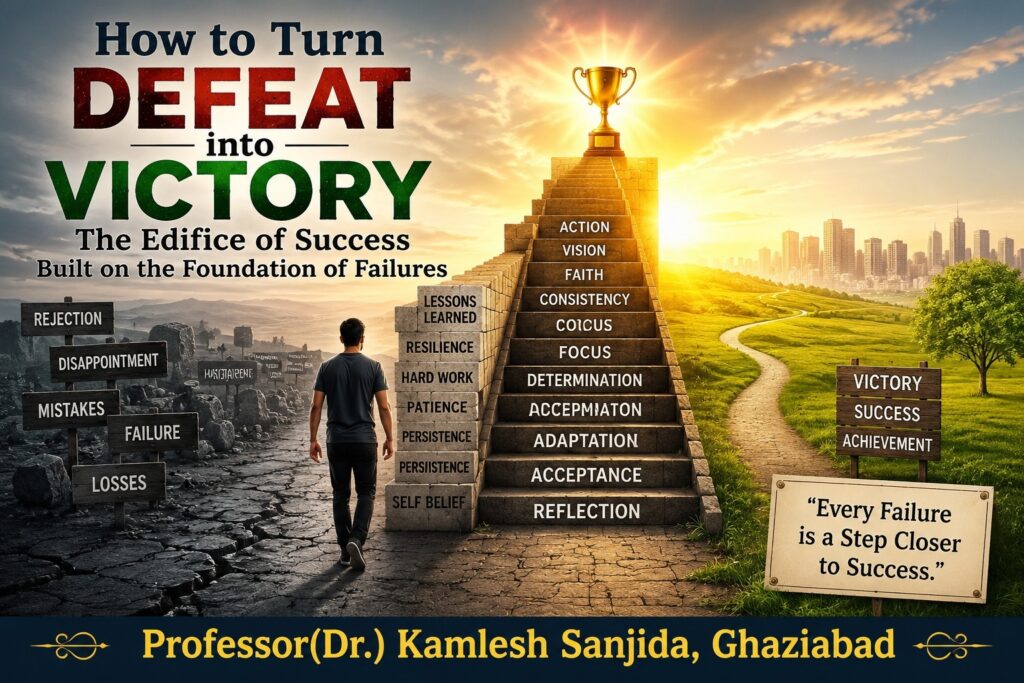
How to Turn Defeat into Victory: The Edifice of Success Built on the Foundation of Failures
Human life is a continuous journey where both success and failure are inevitable, much like the alternation of sunshine and shadow. At some juncture in life, each of us finds ourselves at a crossroads where all our efforts, plans, and hopes lie shattered. Society has cultivated a tradition of viewing success as a celebration and failure as a stigma—a mindset that often shatters an individual from within. From childhood, it is deeply ingrained in our subconscious that falling is bad, losing is shameful, and failure marks the end of the road. Yet, if we turn the pages of history, study the lives of great figures in depth, and understand human psychology, a completely different picture emerges. The reality is that failure is not the end of a journey; rather, it serves as the strongest foundation for the edifice of success. There has never been a great invention, a vast empire, or a groundbreaking success in this world that was not built upon the debris of countless failures. Before the great inventor Thomas Alva Edison successfully invented the electric bulb, he had failed in his experiments ten thousand times. When asked about this, he replied that he had not failed ten thousand times; instead, he had discovered ten thousand ways in which a bulb could not be made. This is not merely a thought, but a revolutionary perspective on life that transforms an ordinary person into an extraordinary one.

Understanding the psychology of failure is crucial because when we fail at a task, the first blow is dealt to our self-esteem. Our brain perceives this failure as a threat. According to psychologists, when a person fails an exam, loses a job interview, or goes bankrupt in business, a profound negative reaction arises within them. In such situations, a person can fall prey to one of two mindsets: a fixed mindset or a growth mindset. Those with a fixed mindset view failure as a personal shortcoming; they believe they are unintelligent, lack talent, and are incapable of achieving anything in life. Conversely, individuals with a growth mindset regard failure merely as an event rather than a defining personal trait. They attribute it to flawed strategies, situational demands, or a lack of experience. The process of cognitive restructuring emphasizes that, upon failing, one should objectively evaluate the situation instead of self-reproach. It is crucial to acknowledge the defeat without allowing the resulting sense of inferiority to overwhelm you. Those who accept their failure and derive a lesson from it become far more mentally resilient and robust.
The journey from failure to success is a gradual, scientific process that can be understood through four key stages. The first stage is ‘identification’—mustering the courage to confront one’s failure directly. People often blame others, circumstances, or fate for their failures; however, recognizing exactly where the error occurred marks the first step toward improvement. The second stage is ‘analysis,’ which involves thinking logically, setting emotions aside. One must deeply review their decisions, methods, and behavior to pinpoint exactly where things went wrong. The third stage is ‘formulating a plan’—devising a new, more practical strategy based on the data and experiences gained from past mistakes. The fourth and most critical stage is ‘trying again.’ This stage demands the greatest courage, as re-entering the arena after a crushing defeat requires immense mental energy. When a person goes through these four stages, their chances of success increase manifold.
READ MORE :
SIMS Annual Day Fest 2026 Celebrated with Grandeur at Sri Ram Centre, New Delhi
Three-Day Theatre Festival at Triveni Kala Sangam Enthralls Audience with Powerful Performances
If we look at the lives of the world’s most successful people, we find that they have all graduated from the greatest university of all—the university of failure. The life of Dr. A.P.J. Abdul Kalam, India’s former President and the renowned ‘Missile Man,’ stands as the most significant and inspiring example of this. In 1979, India’s first Satellite Launch Vehicle (SLV-3) mission was being launched, with Dr. Kalam serving as the project director. It was a momentous occasion for the entire nation. However, just minutes after liftoff, a technical glitch caused the rocket to veer off course and crash into the Bay of Bengal. This was a devastating blow for Dr. Kalam; years of hard work had gone to waste, and the failure drew harsh criticism from the media. At that critical juncture, Satish Dhawan, the then-Chairman of ISRO, demonstrated remarkable leadership. He took full responsibility for the massive failure upon himself, thereby shielding Dr. Kalam from the media’s scrutiny. Far from breaking him, this incident infused Dr. Kalam and his team with renewed energy. They meticulously analyzed their errors, rectified the technical flaws, and exactly one year later, in 1980, successfully placed the Rohini satellite into orbit. This time, Satish Dhawan asked Dr. Kalam to address the media and attribute the success entirely to his team. Dr. Kalam’s story teaches us that failure is not merely a technical issue; it is also the ultimate test of leadership, patience, and team morale.
Another remarkable story is that of Jack Ma, the legendary Chinese entrepreneur and founder of the Alibaba Group. His life is an epic saga of repeated rejections and failures—experiences that could easily have disheartened anyone. He failed his college entrance exams three times. After graduating, when he began searching for a job, he was rejected by thirty different employers in succession. When the first KFC branch opened in his city and 24 people applied for jobs, 23 were hired and only one was rejected—and that person was Jack Ma. Harvard University rejected his application ten times. Faced with so many failures and rejections, an ordinary person might well have lost their self-confidence and given up on life. But Jack Ma turned these rejections into his strength. He recognized the power of the internet and, together with his friends, founded ‘Alibaba.’ For the first few years, the company made no profit, yet he did not give up.
Today, Alibaba is one of the world’s largest e-commerce companies, and Jack Ma is counted among the most successful entrepreneurs globally. His story is living proof that it does not matter how many times the world says ‘no’ to you; what matters is how many times you say ‘yes’ to yourself.
In the fields of technology and science, too, failure is considered an essential stepping stone to progress. Today, Elon Musk’s company, SpaceX, dominates the world of space exploration, yet in 2008, it was on the verge of bankruptcy. SpaceX’s first three rocket launches failed completely, with the rockets exploding in mid-air. Musk had funds left for only one final attempt—the fourth launch. Had that failed, the company would have shut down forever. It was the darkest period of Musk’s life. However, he analyzed every piece of data from the previous three failures, rectified even the smallest flaws, and successfully executed the fourth launch. This success secured a major contract with NASA, and the company was saved. Elon Musk believes that if you are not failing in your work, it simply means you are not attempting anything new or significant. The entire foundation of science rests on experiments and the failures associated with them; before any new medicine, software, or technology reaches the market, it undergoes countless failures in the laboratory. Each failure reveals which path not to take, thereby guiding science toward the right direction.
But when we compare this global and industrial approach with India’s education system and social structure, a great irony is visible. In our country, examination marks have been considered the only measure of a student’s ability and success in life. When a student does not get the desired marks or fails in board exams or competitive exams (like IIT, NEET etc.), he has to listen to the taunts of the family and society. This social pressure is so severe that sometimes innocent students end their lives. It is the biggest collective failure of our society that we have taught our children how to succeed, but have not taught them how to deal with failure. We need to bring about a fundamental change in the environment of our homes and schools. Children need to be taught that a mark sheet cannot decide their entire life. ‘Growth Mindset’ has to be nurtured within them. When a child scores low marks in any subject, instead of scolding him, one should sit with him and analyze where the preparation was lacking. Career counseling and a sensitive evaluation system is the need of the hour. Unless we stop considering failure as a crime, we cannot create a fearless and creative young generation.
In contrast, modern corporate worlds and industries have made failure management an essential part of their functioning. Japan’s famous car manufacturer Toyota developed a culture under the ‘Toyota Production System’, where the emphasis is on exposing failure rather than hiding it. Every employee in his factory has an ‘Andon Cord’. If any ordinary employee notices even a small defect or mistake in the production line, he has the right to immediately pull the rope and stop the work of the entire factory. For this he is not punished, but is praised, because he prevented a major failure before it reached the final product. Similarly, today the big companies of Silicon Valley are working on the policy of ‘Fail Fast’. He believes that instead of taking years to develop a new product, launch a basic model quickly. If it has to fail, it should fail quickly, so that the company can learn from its mistakes and improve the product without wasting much time and money. A company like Google also started many projects like ‘Google Glass’ which failed badly in the market, but instead of hiding those failures, Google took a lesson from them and used the same technology in Augmented Reality and other successful projects. The path of innovation passes through the dense forest of failures.
Now the question arises that how should a common person manage the failures in his personal life? This first requires introspection and self-dialogue. When faced with defeat, treat yourself like a true friend instead of being too hard on yourself. Ask yourself, did I miss any effort? Am I repeating the same mistakes over and over again? Has this defeat made me more experienced and wiser than before? When you search for answers to these questions with complete honesty, the fear within you begins to disappear. Another important strategy is to set ‘micro-goals’ or small goals. After a major failure, a person’s self-confidence becomes zero. In such a situation, instead of setting a very big goal, set small goals in your daily routine. When you accomplish those small goals daily, your mind starts getting back on the winning track and your lost confidence slowly starts returning. Along with this, the practice of visualization (positive imagination) is also very effective. The ability to see yourself succeeding in the future even in the darkness of your failure is a great psychological strength.
In conclusion, it can be said that failure is not a full stop to life, rather it is a comma, which gives you a chance to stop, think carefully and move forward with more preparation. All the great personalities of the world did not become great because they never fell; Rather, they became great because each time they fell, they stood up with greater strength than before. The real joy of victory in life comes only to the person who has deeply felt the bitterness of defeat. Failure humbles us, makes us aware of our shortcomings and brings out the indomitable courage hidden within us of which we are unaware. So, whenever life throws you down, whenever all your plans fail, and whenever darkness appears all around, remind yourself that this is not the end. Don’t let your defeat become your identity, rather make it a stepping stone to your success. The day you stop being afraid of your failures and start learning from them, your real victory will begin. The tallest and strongest buildings of success are built on the debris of failures, all that is needed is the courage to remove that debris and lay a new foundation.
Author: Professor (Dr.) Kamlesh Sanjida, Ghaziabad