Religion, Irreligion and Humanity: Kuldeep Vashishth Explores Morality Through Three Plays
Religion, Irreligion and Humanity: Kuldeep Vashishth Explores Morality Through Three Plays
Book Review
Reviewer: Ritesh Sinha
Book Title: Religion, Irreligion and Humanity (Dharm, Adharm aur Insaan)
Author: Kuldeep Vashishth
Editor: Rizwan Raza
Pages: 160
Publisher: Pices Books, Lucknow
Literature is not merely a medium of entertainment; it is also a powerful instrument for reflecting society, questioning established beliefs and encouraging individuals to look within themselves.
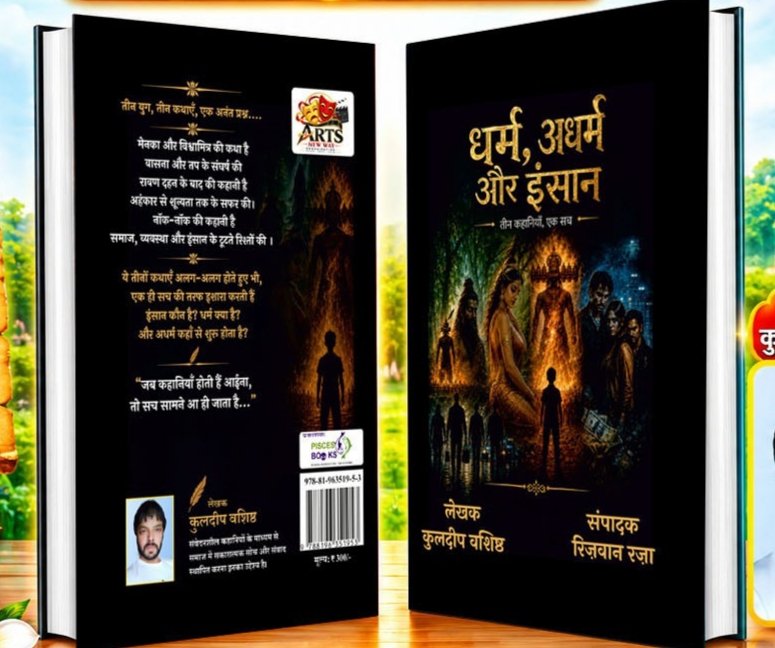
Kuldeep Vashishth’s book, Religion, Irreligion and Humanity, emerges as a noteworthy contribution to this literary tradition. The 160-page volume brings together three plays. Although their themes differ, all three revolve around a common question: What role do religion, principles, morality and circumstances play in shaping human life? The title itself gives this question a broader philosophical dimension. Moving from mythological narratives to the complexities of contemporary life, the author attempts to explore how human conduct is shaped not only by personal beliefs and values but also by the circumstances in which individuals find themselves.
The first play, After the Burning of Ravana, offers an opportunity to examine the relevance of the Ramayana in contemporary society. Traditionally, the burning of Ravana’s effigy on
Vijayadashami is celebrated as a symbolic victory of good over evil. Every year, Ravana’s effigy is set ablaze, celebrations follow, and society considers itself aligned with the forces of truth and righteousness. But does burning an effigy alone eliminate evil from society? Was evil confined to a mythological character, or do its various manifestations continue to exist in our social and personal lives? The play brings such questions to the forefront of its philosophical exploration.
Through the characters of Lord Rama and Ravana, the narrative opens up a discussion on truth, falsehood, dignity, power, arrogance and morality. At a time when both individuals and society are confronted with numerous ethical dilemmas, understanding the true meaning of the ideals represented by the Ramayana and incorporating them into everyday conduct becomes increasingly important. The play encourages readers to reflect on the idea that the burning of
Ravana becomes meaningful only when individuals also make a conscious effort to eliminate the arrogance, injustice and negative tendencies within themselves.
The second play, Brahmarishi Vishwamitra, explores the ideological and personal conflict between two highly influential figures of Indian mythological and spiritual tradition—Maharishi
Vashishtha and Vishwamitra. Both are revered sages, scholars and distinguished representatives of the ancient tradition of spiritual wisdom. Their conflict, however, is not merely a contest between two individuals for recognition or prestige. It encompasses deeper questions of ego, self-respect, penance, spiritual discipline, knowledge and the true meaning of spiritual achievement.
Vishwamitra’s journey from Rajarishi (a royal sage) to Brahmarishi is regarded in Indian mythology as a significant example of self-transformation and perseverance through spiritual discipline. On the other hand, Maharishi Vashishtha represents knowledge, patience and spiritual composure. Through these two characters, the author invites readers to consider what truly defines greatness—power, position, prestige, penance, spiritual practice or self-restraint? Can a person attain greatness merely through rigorous penance, or is the elimination of ego equally essential?
The real test of an individual lies in conduct, patience and self-realisation. The conflict between Vashishtha and Vishwamitra remains relevant even today because, in modern society, the distinction between knowledge and position, merit and prestige, and self-respect and arrogance often becomes blurred. The significance of this play lies in its ability to use mythological characters to offer insights into the struggles that take place within the human mind.
The third play, Knock Knock, differs from the first two in both its subject matter and emotional landscape. While the earlier plays explore larger questions of life through mythological characters and spiritual discourse, Knock Knock examines the personal circumstances, helplessness and moral struggles of modern human beings. It portrays the conflict of an individual caught between spirituality, principles, personal decisions and the harsh realities of life.
On one side of its narrative are idealistic views of life and moral principles; on the other are circumstances in which an individual is compelled to confront the question of survival and the responsibility of protecting one’s family. The struggle to save a mother’s life gives this conflict a deeply emotional dimension. When someone is faced with the challenge of saving a loved one’s life but has limited resources, what kind of conflict emerges between personal principles and practical decisions? Is an act committed under compulsion as morally blameworthy as an offence driven by selfishness or greed? Through serious subjects such as theft and suicide, the play provides an opportunity to understand the complexities of life and the human psychological condition.
The author’s challenge here is not simply to portray an individual’s wrong decision but also to understand the circumstances that led that person to such a difficult point. No society can justify crime, but neither can it afford to ignore the social, economic and family circumstances that may lie behind it. Understanding this sensitive distinction is central to the play’s intellectual value. It encourages readers to look beyond immediate judgments and understand the struggles hidden behind other people’s decisions.
When these three plays are read together, the broader intellectual framework of the book becomes more apparent. After the Burning of Ravana raises questions of morality through society and religious symbolism. Brahmarishi Vishwamitra examines spiritual discipline, ego and self-transformation, while Knock Knock brings to light the conflict between personal helplessness and moral principles. In this way, the book journeys from mythological consciousness to the realities of modern social life.
The thought behind the publication of this book is also particularly noteworthy. There was a time in the literary and theatrical world when established and celebrated writers and prominent playwrights received greater opportunities in publishing, stage performances and literary discourse. Their works enjoyed wider platforms and greater readership, while many talented writers from smaller cities and towns, as well as emerging literary voices, had limited opportunities to demonstrate their creative abilities. Despite possessing original ideas and considerable potential, many new writers often remained outside the literary mainstream due to a lack of appropriate platforms and encouragement.
In such an environment, providing opportunities to emerging writers, publishing their works and bringing them before readers is itself an important literary initiative. The positive intention behind Religion, Irreligion and Humanity appears to reflect precisely this objective. The purpose of the book is not merely to bring three plays together in a single volume but also to encourage new talent and provide writers with a platform for creative expression.
READ MORE :
SIMS Annual Day Fest 2026 Celebrated with Grandeur at Sri Ram Centre, New Delhi
Three-Day Theatre Festival at Triveni Kala Sangam Enthralls Audience with Powerful Performances
The initiative undertaken by author Kuldeep Vashishth and editor Rizwan Raza in this direction deserves appreciation. Their effort represents an attempt to open new possibilities for emerging writers in the literary world. It should not be viewed merely as the publication of a book but as a meaningful and ambitious endeavour to provide new writers with recognition, opportunities and encouragement. Such initiatives are particularly important for strengthening the literary ecosystem and ensuring that promising voices are not lost due to a lack of exposure.
Overall, Religion, Irreligion and Humanity is more than a collection of three plays. It is a literary exploration of the human conscience, beliefs, ego and helplessness. The book offers compelling reasons to read, understand and reflect upon its themes. Its commitment to encouraging emerging writers further elevates it beyond an ordinary literary collection, positioning it as a meaningful initiative towards expanding creative opportunities and making the literary space more inclusive.