Indian Researchers Show How Graphene Oxide Droplets Create Spider-Web and Mosaic Patterns
Indian Researchers Show How Graphene Oxide Droplets Create Spider-Web and Mosaic Patterns
# A drying droplet can leave behind a spider-web pattern or a mosaic-like pattern, depending on the structure of its graphene oxide sheets.
New Delhi:
From checking drinking-water quality to tracking pollution and detecting health problems early, India needs affordable sensors that can work beyond specialized laboratories. A new study by researchers from DIT University, IIT Bombay, and the Bhabha Atomic Research Centre takes a step in that direction by showing how graphene oxide droplets can be guided to form precise patterns—like spider webs or mosaics—as they dry.
The challenge begins with a simple phenomenon seen in many homes: a drop of coffee drying on a table and leaving a dark ring. As water evaporates, it carries the suspended particles towards the edge. Scientists call this the coffee-ring effect. Although familiar, this behavior can create serious problems when engineers try to print electronic materials or make sensor surfaces. They need the material to settle evenly, in a controlled and predictable pattern.
A new study in Langmuir, a preeminent journal of the esteemed American Chemical Society, shows how researchers in India can steer this process. A team from DIT University, IIT Bombay, and the Bhabha Atomic Research Centre found that graphene oxide can leave behind two strikingly different designs. Depending on the size of its nanosheets and the amount of oxygen attached to them, a drying droplet can look like a spider web or a mosaic. The finding could help researchers control how materials are placed on a surface for printed electronics, coatings, and potentially supercapacitors.
A tiny droplet with a big design problem
Graphene is a sheet of carbon just one atom thick. It is known for being exceptionally strong and for conducting heat and electricity well. Graphene oxide is a chemically modified form of graphene. Oxygen-containing groups cover its surface, allowing the sheets to mix more easily with water. This combination makes graphene oxide attractive for printing electronic components and making advanced coatings.
But the sheets do not simply drift around as separate flakes. In water, they can arrange themselves into layers. The mixture still flows like a liquid, but the sheets retain some of the order seen in crystals. Scientists call such materials liquid crystals. This hidden organisation affects how the mixture flows and what remains after the water has evaporated.
That led us to a simple question: can the final pattern be controlled by changing two features of the sheets—their size and how much they are oxidised?
One material two very different patterns
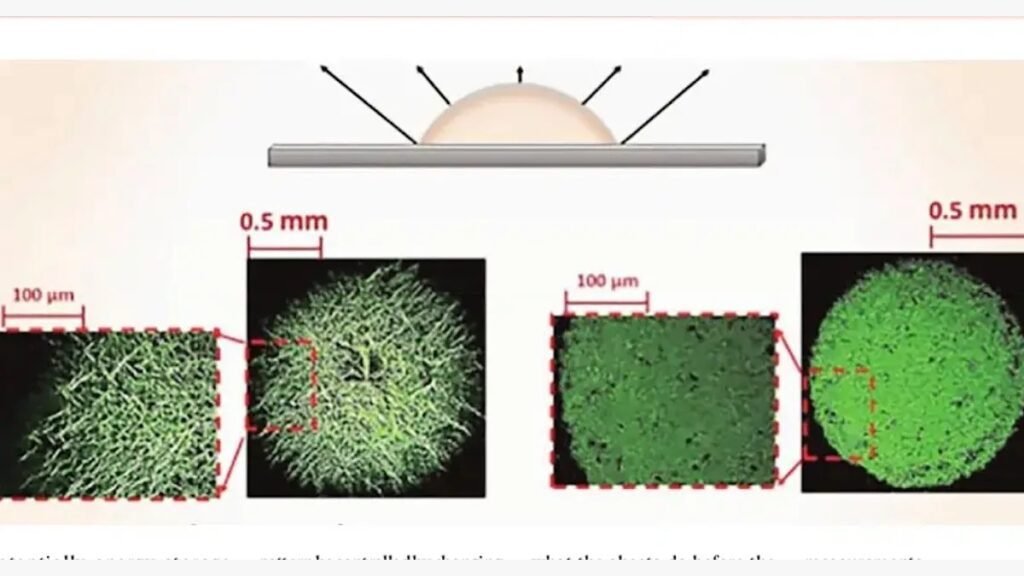
The answer was yes. Larger sheets, about 2.2 micrometres across, with relatively little oxygen attached to them produced thin stripes radiating from the centre towards the edge. The dried droplet looked like a spider web. The material had a carbon-to-oxygen ratio of 14.4.
Smaller sheets, about 0.5 micrometres across, with more oxygen on their surfaces produced a very different deposit. Instead of long stripes, they formed many small bright regions across the droplet, resembling mosaic tiles. This material had a lower carbon-to-oxygen ratio of 10.4, showing that it was more strongly oxidised.
The hidden mechanics behind the patterns
The explanation begins with what the sheets do before the droplet dries. The larger, weakly oxidised sheets form loosely connected stacks. They tend to point in similar directions, but they are not locked into fixed positions. Imagine a stack of paper: the sheets are broadly aligned, yet they can slide and buckle.
As evaporation makes the droplet smaller, the liquid presses this loose assembly against the surface. Like paper squeezed in a hand, the sheets wrinkle. The wrinkles gather into radial stripes, producing the spider-web pattern.
The smaller, more strongly oxidised sheets assemble more tightly. They are ordered not only in direction but also in position—more like a stack of bricks than a stack of paper. This structure is more rigid, so the sheets resist the wrinkling caused by evaporation. Instead of forming long folds, the deposit breaks into compact, mosaic-like regions.
X rays and flow tests reveal the answer
To test this explanation, the team used two kinds of measurements. First, synchrotron-based small-angle X-ray scattering at the Indus-2 facility of the Raja Ramanna Centre for Advanced Technology in Indore showed how the graphene oxide sheets were arranged inside the suspensions. The measurements confirmed the contrast between the loosely organised and highly ordered assemblies.
Second, rheology—the study of how materials deform and flow—revealed a matching difference in behaviour. The weakly bound sheets could not withstand much shearing and flowed readily, like a
liquid. The strongly bound sheets responded elastically, more like a soft solid. In short, the internal order of the sheets changed the mechanical character of the suspension, and that mechanical character helped determine the pattern left on the surface.
Why this could matter for printed electronics
Drying patterns matter whenever a liquid is used to place a useful material on a surface. Examples include inkjet-printed electronics, biosensors, coatings, and energy-storage devices. A predictable deposit is easier to design around than one that changes from sample to sample or leaves behind an unwanted ring.
The study shows that sheet size and oxidation level are practical controls for tuning these patterns. It also helps explain why different commercial graphene oxide samples can behave differently: their structures may vary depending on how they are made. Instead of treating that variation only as a problem, manufacturers could use it to choose a suspension with the flow behaviour and final pattern best suited to a particular application.
A drying droplet may look simple, but inside it is a tiny assembly line. The sheets organise themselves, the liquid flows, the structure stiffens, and evaporation writes the final pattern. Understanding that sequence could bring researchers closer to printing complex materials exactly where they are needed.
A possible Indian use case
India needs affordable ways to monitor water quality, detect health problems early, and track pollution across cities, towns, and villages. Printed electronics could eventually help make some sensors cheaper and easier to produce because their active materials can be deposited directly onto small surfaces.
READ MORE :
SIMS Annual Day Fest 2026 Celebrated with Grandeur at Sri Ram Centre, New Delhi
Three-Day Theatre Festival at Triveni Kala Sangam Enthralls Audience with Powerful Performances
This study does not demonstrate a finished water or medical sensor. Its contribution is more basic but important: it shows how to control the way graphene oxide dries and settles. In the future, that control could help researchers make the active layers of printed sensors more uniform and reproducible. For technologies meant to work beyond specialised laboratories, reliable manufacturing can be as important as the material itself.