Sir Syed Ahmad Khan: The Pioneer of Educational Awakening among Indian Muslims
Dr. Ihtiram Raza Khan, Jamia Hamdard
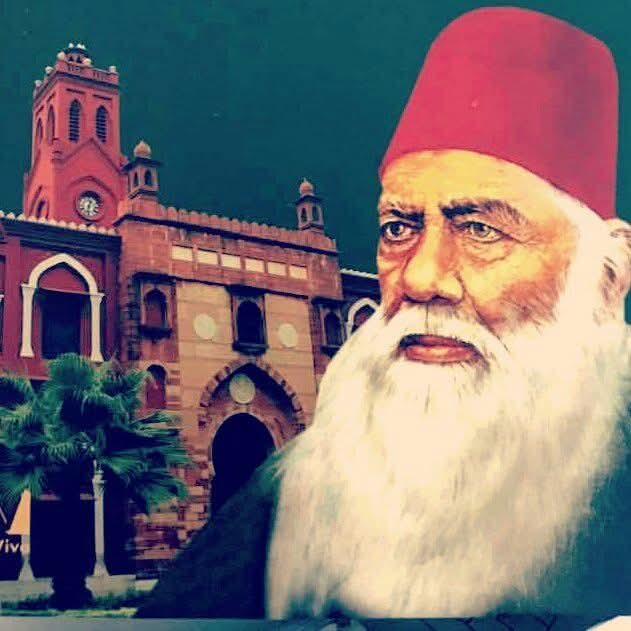
Sir Syed Ahmad Khan stands as a luminous figure in the history of Indian Muslims — a visionary who not only revolutionized education but also left an indelible impact on the intellectual and social landscape of the community. Born in Delhi on October 17, 1817, Sir Syed deeply realized the backward condition of Muslims during British rule, when education had become the key to status and progress, yet Muslims remained distant from it. He understood that the path to the social, economic, and political empowerment of Muslims lay only through modern education.
In 1864, he founded the Scientific Society in Ghazipur with the purpose of translating Western scientific and educational works into Urdu, so that modern knowledge could reach Muslims in their own language. This initiative was not merely an act of translation but a movement toward transforming the collective mindset. Sir Syed believed that no community could progress without acquainting its youth with modern sciences, English, and contemporary thought.
In 1875, he established the Muhammadan Anglo-Oriental College at Aligarh, which later evolved into the Aligarh Muslim University (AMU). This institution became a remarkable blend of Western education and Islamic values, where English, science, and literature were taught alongside Arabic and Islamic studies. The Aligarh Movement instilled self-confidence and a new outlook among Muslims, and graduates from this institution went on to distinguish themselves in government services, academia, journalism, and social reform.
Sir Syed’s vision, however, was not confined to education alone. He was a social reformer who advocated for women’s education, reform in the practice of purdah, and communal harmony. Through his journal Tahzib-ul-Akhlaq, he propagated rational and progressive ideas, encouraging Muslims to embrace enlightenment and reform. Sir Syed promoted a rational interpretation of Islam and revived the principle of ijtihad, urging Muslims to reinterpret their faith in the light of reason and the changing circumstances of their time.
His ideas became a turning point for the Muslim community. He demonstrated that modernity and religious faith are not contradictory but complementary. Through education, he gave Muslims a sense of self-respect and identity. The Aligarh Muslim University stands today as the realization of his dream and a living symbol of his intellectual legacy.
Mahatma Gandhi once called him the “Prophet of Education,” a title that aptly defines his contribution. Sir Syed proved that education is not only the light of the mind but also the discipline of the soul. He believed that true learning enlightens the intellect and refines the spirit.
In today’s world, where the challenges of education, reason, and identity are again at the forefront, Sir Syed’s vision appears more relevant than ever. He taught the Muslim community that one can embrace modern knowledge while preserving cultural and religious values. This balance, he believed, is the true foundation of a progressive society.