Literary Event by Authors Guild of India
Reyasat Ali Sameer
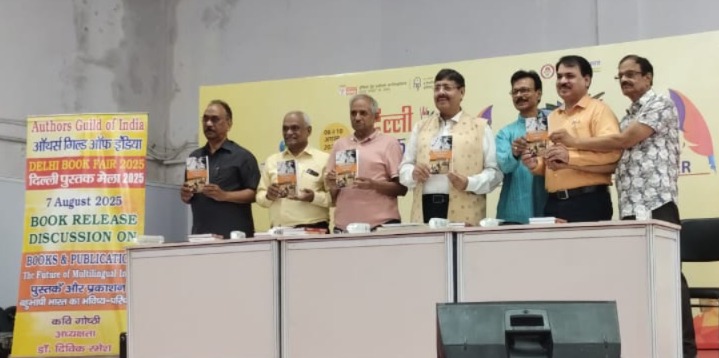
New Delhi : During the Delhi Book Fair at Pragati Maidan, the Authors Guild of India organised a one-day literary programme. The event began with the release of books authored by members of the organisation, including Dr. Sandeep Kumar Sharma, Dr. Ajay Kumar Ojha, Dr. Yasho Yash, Meena Kumari, and Rama Verma Shyam. Following the book launch, a discussion was held on the topic “Books and Publishing: The Future of Multilingual India”. The discussion was chaired by Dr. Mukesh Agrawal, Vice President of the Authors Guild, and conducted by the organisation’s General Secretary, Dr. Shivshankar Awasthi. Speakers included Dr. Harish Arora, Dr. Rakesh Pandey, Dr. V.K. Shekhar, Dr. Yuvraj Singh, and Dr. Harisingh Pal.
Opening the discussion, Dr. Shivshankar Awasthi highlighted that India is a multilingual nation where unity exists in diversity, with 122 languages and 1,652 dialects or folk languages. He categorised all languages into four main types and emphasised that the preservation of languages and dialects requires not only writing but also publishing. Dr. Awasthi also spoke about the literary events organised by the Authors Guild of India across the country to promote writing and publishing.
Dr. Harish Arora stated that India has a variety of castes, dialects, and languages, and books are essential for understanding them. He referred to the government’s policy on mother-tongue education and stressed the need to create books. According to him, everyone should be multilingual so that through translation, we can truly understand each other. He added that writing is essential, and so is publishing — this is both the responsibility of the writer and the publisher.
Dr. Rakesh Pandey spoke about the relationship between authors and publishers, sharing the experiences of several writers. He stressed the need for publishers to be honest about royalty payments. He pointed out that multilingualism is benefiting English more than Indian languages. Speaking on publishers’ responsibilities, he noted that authors are often not informed about institutional purchases of their books. Regarding the Eighth Schedule of the Indian Constitution, he suggested either removing it or including all languages in it.
Dr. Virendra Shekhar described the topic as complex yet significant, stating that publishers would welcome authors and take interest in publishing only if the writing is strong. He mentioned Amish Tripathi’s recent works and the publication of the Upanishads, and also discussed the linguistic knowledge and literary excellence of eminent figures such as Firaq Gorakhpuri, Dr. Rajendra Prasad, Pandit Jawaharlal Nehru, Harivansh Rai Bachchan, and others.
Dr. Yuvraj Singh called the subject serious and important, noting that disputes over multilingualism are more common today than in the past. He lamented the lack of readers and said that despite the changing environment, books have no substitute. While textbooks are read out of necessity, the reading of other books has declined sharply, leaving many library books gathering dust.
Dr. Harisingh Pal said that we are indebted to books. From a library science perspective, he pointed out that a book requires a reader, and while some libraries have no readers, others are overcrowded. He expressed concern that the number of books purchased for libraries has decreased significantly, and folk songs are disappearing. He noted that the Authors Guild of India is consistently working to preserve multilingualism.
In his presidential address, Dr. Mukesh Agrawal remarked that in the oral tradition, much is lost, making writing essential. He added that e-books cannot and should not replace printed books, though they are a necessity of the times. He stated that only those creations that have substance survive. Speaking about translation, he said that even artificial intelligence can perform translations. He emphasised the need to write meaningful literature, find publishers for it, and recognise the importance of translation.
In the second session, a multilingual poetry recital was held under the chairmanship of Dr. Divik Ramesh. Poets who participated included Dr. Harisingh Pal, Dr. Rakesh Pandey, Dr. Kamal Kishore Kamal, Dr. Shivshankar Awasthi, Atul Prabhakar, Radheshyam Bandhu, Dr. Yuvraj Singh, Anjali Awasthi, Yasho Yash, Dr. Umakant Khubalkar, Jai Bahadur Singh Rana, Dr. V.K. Shekhar, Dr. Ajay Kumar Ojha, Arun Kumar Paswan, Neelam Shukla, among a total of twenty-seven poets.
In his closing address, Dr. Divik Ramesh thanked all the poets and praised the Authors Guild of India for not imposing any restrictions on language or poetic form. His simple, concise yet outstanding poem captivated both the poets and the audience.