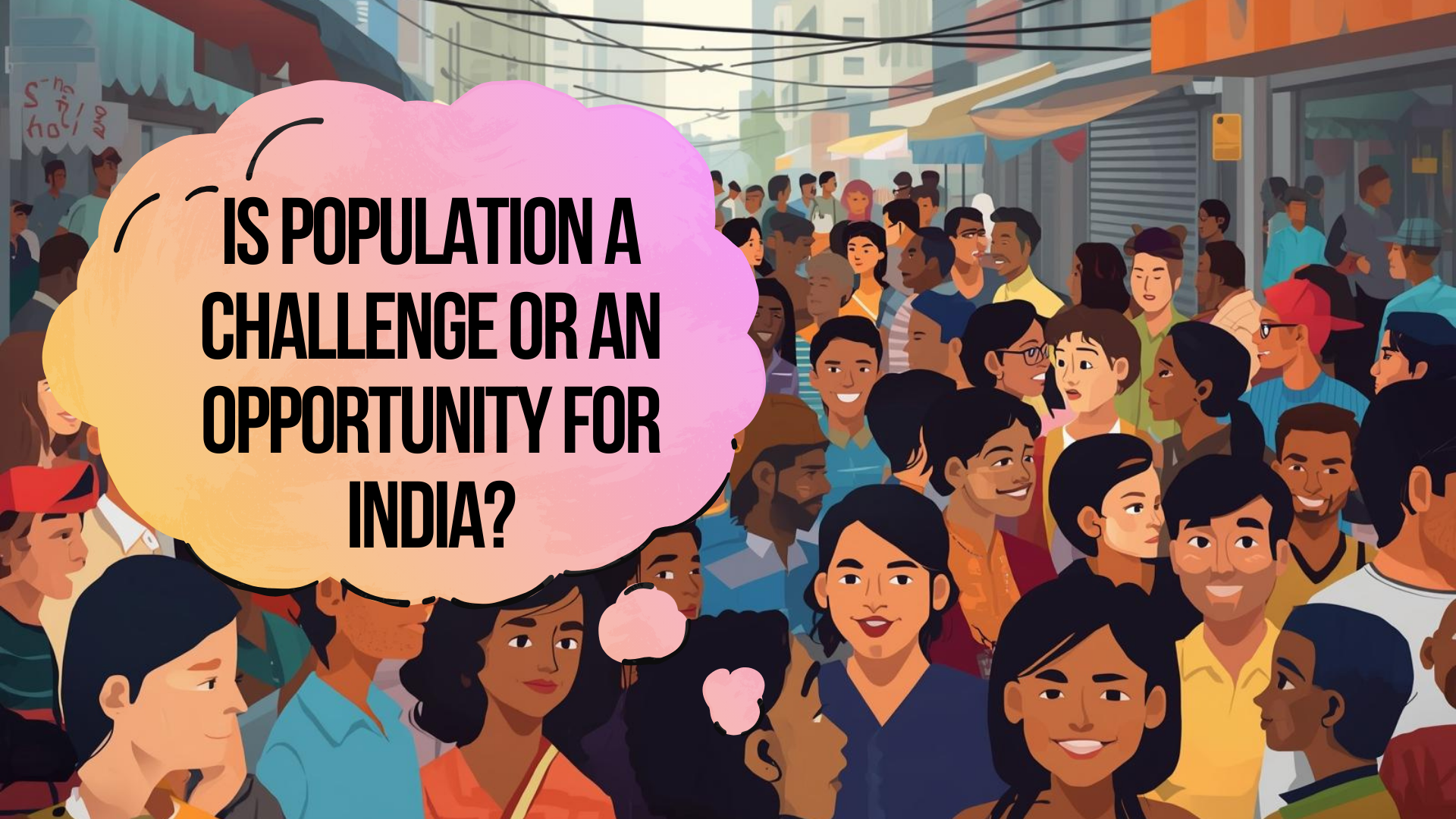
Is Population a Challenge or an Opportunity for India?

The issue of population in India has always remained a subject of debate. Recent data released by the Indian Association for the Study of Population has further intensified this discussion. According to the association, India has witnessed a significant decline in its Total Fertility Rate (TFR). While the TFR stood at 3.5 in the year 2000, it has now declined to 1.9. This means that, on average, a couple—or two individuals together—are giving birth to fewer than two children. It is estimated that by the year 2080, India’s total population will stabilize between 1.8 and 1.9 billion.
A section of analysts views this trend as a challenge, while another considers it an opportunity. In this context, the much-debated population discourse between Paul Ehrlich and Julian Simon has once again become relevant. Paul Ehrlich described population growth as a “population bomb” and considered it a major challenge, whereas Julian Simon did not view population growth negatively. He argued that population growth is essential for industrial development and a consumer-based economy. Similar differences of opinion exist in India as well.
The key question, therefore, is: what does the current fertility rate mean for India’s economic growth and social stability? It is important to examine what lessons India can learn from countries that have already experienced such demographic changes. It is also necessary to understand under what circumstances population emerges as a strength for a country and when it turns into a challenge. For a long time, there has been a demand in India for a population control law; the present scenario calls for a careful assessment of how necessary such a law actually is today.
To begin with, it is essential to understand the concept of Total Fertility Rate. TFR indicates the average number of children a woman is expected to give birth to during her reproductive years. The replacement level is considered to be 2.1; at this level, the population neither grows nor declines. When the fertility rate falls below this level, the population gradually starts shrinking—and India is moving towards this phase.
The decline in India’s fertility rate is the result of multiple factors. Family planning initiatives and social acceptance of the “small family” norm have contributed significantly to reducing birth rates. Attitudes towards marriage and motherhood are changing, with women increasingly prioritizing careers and economic independence. Improved education among women and greater gender equality have reduced son preference. Expectations of high-quality upbringing and better healthcare facilities have also encouraged smaller families. In addition, declining infant mortality rates and increased use of contraceptives have further contributed to lower fertility. Undoubtedly, this changing demographic profile will have a significant impact on India.
A declining fertility rate presents both opportunities and risks for India’s socio-economic future. On the positive side, lower fertility can yield substantial economic, social, and environmental benefits. Families can invest more in the education, health, and nutrition of children, leading to an improvement in the quality of human capital. However, the other side of the picture is equally concerning. A prolonged decline in fertility can gradually shrink the labor force, consumer base, and savings rate, potentially limiting economic growth. A rapidly increasing elderly population will put immense pressure on healthcare systems, pensions, and social security mechanisms.
Global experiences provide a clear warning regarding the demographic transition India is undergoing. In many countries, once the fertility rate falls below the replacement level of 2.1, it becomes extremely difficult to raise it again. South Korea is a striking example, where the fertility rate declined from 0.78 in 2022 to 0.73 in 2023, despite the government spending billions of dollars to encourage family expansion. In Japan, low fertility has weakened the labor force, resulting in the economy shrinking from around USD 6 trillion to nearly USD 4 trillion over the past decade. Recognizing this challenge, China abolished its “one-child policy” and allowed up to three children, yet its fertility rate has failed to rise above 1.3. The experiences of Taiwan, Singapore, and Italy show that a sharp decline in fertility can destabilize a country’s long-term economic capacity, social security systems, and political stability.
Understanding India’s demographic structure is equally important. According to data from the United Nations and the U.S. Census Bureau, India surpassed China in 2023 to become the world’s most populous country, a position it continues to hold in 2025 with a population exceeding 1.44 billion. India is expected to remain the most populous country for many years to come. The positive aspect is that India is currently a young nation, with relatively fewer children and elderly people. The working-age population (15–64 years) constitutes about 68% of the total population. As of 2025, approximately 961 million people fall within this age group. This means India is currently enjoying a demographic dividend. However, this advantage may not last forever. Over time, today’s youth will enter the elderly age group, and with declining fertility rates, the proportion of elderly citizens may surpass that of the young. Such a scenario could place a heavy burden on the economy.
The debate on whether population should be viewed as a challenge or an opportunity often overlooks a crucial reality: population is both. It becomes a challenge when it turns into a burden, but it becomes an opportunity when it is transformed into a resource. No resource is inherently wasteful if utilized effectively—and human beings are also a resource, provided they are used productively. Transforming this responsibility into an asset may seem difficult, but it is possible. By ensuring access to nutritious food, healthcare, education, skills, gender equality, and employment, population can be converted into an opportunity. In India, the inadequacy of some of these efforts is what often forces population to be seen as a challenge.
For India, it is essential to adopt a multi-dimensional strategy to convert demographic transition into an opportunity. Such a strategy must place health, education, skill development, and employment at its core so that the young population can be transformed into a productive workforce. Special efforts are required to promote gender equality and ensure women’s participation in the labor force. According to the International Monetary Fund, if women’s participation in India’s workforce is raised to the same level as men’s, India’s GDP could increase by up to 27%.
Keeping future risks in mind, it is equally important to strengthen economic security, social and psychological support, reskilling initiatives, and flexible employment options for the elderly. Moreover, balanced policy dialogue on delimitation and family planning is necessary to address political and social challenges arising from regional fertility disparities. In view of rising infertility, easy access to reproductive health services must also be ensured. It is worth noting that India’s population is its real strength, which is why countries across the world look at India with respect today. In this context, given the current demographic scenario, it is more important than enforcing a population control law to make integrated efforts to utilize the demographic dividend in the national interest—before it turns into a demographic disaster.
Author Profile
Mohammad Zubair
Master of Social Work (MSW) – Gold Medalist
NET/JRF – Social Work
Specialization: Industrial Relations and Personnel Management (IRPM)
Current Address: Mukherjee Nagar, Delhi – 110054