Will India become a world Leader by closing 5,000 government schools?

Bharat Bhushan
Journalist
A PIL has recently been filed in the Supreme Court against the closure of 5000 government schools in Uttar Pradesh. The petition said that this move of the government will force more than three lakh fifty thousand students in the state to take admission in private schools. Education is the foundation of the development of any nation. A strong education system promotes a skilled workforce, innovation and economic growth.
Since primary education is not given any priority in the political agenda in this country, this country with the largest youth population in the world is still struggling with illiteracy and poor education. According to the recently published eighth India Skill Report, in a country where religion and religious identity are most important for both the public and the government, it is not surprising that more than 50 percent of graduates are not employable.
In February this year, the central government had told that in the last 10 years, 89 thousand government schools have been closed in UNESCO. Most of these 25 thousand schools were from Uttar Pradesh alone. To avoid adding more burden to our hearts with 5 thousand more schools being closed, the Yogi government has named this scotch of closing schools as pairing scotch. In the year 2015-16, there were about 1 lakh 62 thousand primary schools in Uttar Pradesh. Which remained only 1 lakh 40 thousand in the year 2021-22. That is, this number has decreased as compared to 2015-16. The government’s argument is that it is better to close the schools in which the number of children is less than 50. But the question is, why are these Scottish children not there? Did the number of children decrease on their own, or are the government’s policies responsible for this? According to the ETV-Bharat News website, the figures that have come out on the basis of the U-DISE portal are worth seeing. According to the data, there are about 30,000 primary and upper primary schools in the state, which are in dilapidated condition. Where 742 schools are completely ruined. After this, the condition of occupation in 690-690 in Jungle and 674 in Jungle, 643 in Garib, 641 in Garib and 633 in Ballia is very bad. In these schools, there is neither incomplete construction for the children, nor toilets, nor drinking water and neither boundary wall. Sometimes the material for mid-day meal does not come, sometimes the roof leaks. There is no local electricity. Sometimes shoes get drowned in the school itself. So why would anyone send their children to such a kitchen? When there are no teachers in the school, how will studies take place? In the schools where teachers are posted, their duty is put on election, survey, planning or religious events. The school exists only in records. The classroom is closed, the campus remains deserted. Then when the children do not study, the family members either send their children to private schools or make them leave their studies. That is, gradually the children of government schools stop coming. Then one day the government reports, “The number of students is low, the school will be closed.”
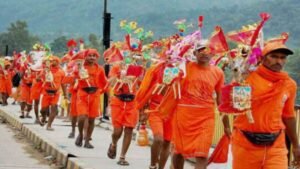
Holidays are declared repeatedly in the name of security in the remaining schools that are running. In Uttar Pradesh, the Kanwar Yatra is no longer just a religious tradition, it has become a government organizing institution. Every year as soon as Sawan arrives, the entire government machinery of the state runs in one direction – serving the pilgrims. From the Health Department to the District Administration, from the Health Department to the Municipal Corporation, every department is ordered that “there should be no shortage in the facilities of the Kanwariyas.” Camps, medical camps, mobile stadiums, mist fans, even salt water are poured at various places. And all this funding comes from the government treasury.
According to a statement issued after the United Nations held a special meeting related to global education to assess the state of education after Covid-19, the Covid pandemic has wiped out the achievements made in the field of education all over the world in the last 20 years. More than 10 crore additional children across the world have been deprived of the minimum level of literacy. The report also brings out the fact that in the backdrop of this global situation, it is not difficult to understand how few students in India have been able to study through the internet during the times of Covid. According to the report, only 18 percent of the rural areas of the country had access to the internet, but how many of them were actually able to use it is also doubtful because many questions like money to buy data packs, electricity to charge mobiles, etc. are related to it. The report shows that 42 percent of urban areas have internet facility, but how many students living in urban poor settlements were able to take advantage of it is also a question. Apart from this, the report also states that more than 62 percent of teachers at the higher secondary level in private schools are not fully qualified. In such a situation, even if the teachers try to work to their full potential, how successful they will be in this, only time will tell. In the end, the report also gives ten suggestions through which quality education can be made available to everyone in the country. The most important among these is to increase the number of teachers in schools in the Northeast and rural areas and to arrange for their proper training.
Overall, to arrange for adequate number of teachers in schools, to open as many schools as possible in the government sector so that poor and rural children are not deprived of education due to fees etc.