India’s Ambitious Energy Plans: A New Chapter in Upstream Exploration
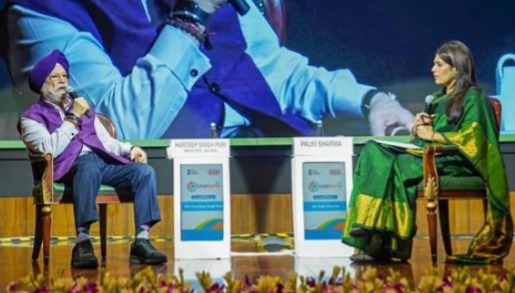
New Delhi : Minister of Petroleum and Natural Gas Minister Puri laid out India’s comprehensive strategy for strengthening upstream exploration and production (E\&P), energy resilience, and international cooperation while speaking in a fireside chat session organised on sidelines of Urja Varta 2025.
Addressing questions on India’s energy security posture amid global geopolitical disruptions such as the Russia-Ukraine conflict and tensions in the Middle East, Shri Puri stated that India had proactively expanded its crude import sources from 27 to 40 countries. This diversification, he said, is a key measure to ensure uninterrupted energy access during periods of global turbulence. On the topic of Russian oil imports, he clarified that Russia remains one of the world’s top oil producers with an output exceeding 9 million barrels per day. He warned that a sudden removal of this supply from the global market—out of a total of approximately 97 million barrels per day—would have created chaos, pushing prices to between $130–$200 per barrel. Shri Puri categorically stated that India has never purchased any sanctioned cargo and that Russian oil was not under global sanctions but only a price cap, carefully structured to reflect ground realities of the international energy supply chain. He credited PM Modi’s leadership for India’s proactive and balanced approach, which has made the country a net stabilising force in global energy markets.
Shri Puri highlighted a series of transformative policy reforms introduced over the last decade to make India’s upstream sector globally competitive. Among the major changes, he mentioned the reimagined exploration framework under the Oilfields Regulation and Development Act (ORDA), characterised by a co-designed approach, a single lease and approval mechanism, transparent operational rules, and the introduction of a “no-sit” clause to eliminate inactive acreage. These measures, integrated with the revised Petroleum and Natural Gas Rules (PNG Rules 2025) and the Model Revenue Sharing Contracts (MRSC), aim to simplify business operations and attract private investment. The Minister acknowledged that the Hydrocarbon Exploration and Licensing Policy (HELP) and amendments to the ORD Act have opened nearly 1 million square kilometres of previously inaccessible “No-Go” areas to exploration, thereby unlocking significant resource potential.
Reaffirming India’s ambitions in offshore energy, Shri Puri spoke of the significant hydrocarbon potential of the Andaman Basin, drawing comparisons with the prolific Guyana basin. He expressed strong optimism, stating, “I am positive we will find several fields of the size of Guyana, particularly in the Andaman Sea.” This confidence is rooted in India’s expanding access to high-quality geoscientific data, robust regulatory support, and policy incentives aimed at de-risking exploration investments. He underscored India’s goal of becoming the next credible frontier for deepwater oil and gas exploration by leveraging scale, demand continuity, and global partnerships.
The Minister elaborated on India’s focus on enhancing subsurface intelligence through the expansion and modernisation of the country’s seismic database. He highlighted the government’s thrust on conducting extensive seismic surveys, adopting advanced technologies, and democratising data access through the National Data Repository. These efforts, he said, are central to ensuring greater investor confidence and fostering transparent, data-driven decision-making in exploration.
Responding to concerns around long-term supply security in light of ongoing sanctions on Iran and Venezuela, Shri Puri questioned the permanence of such restrictions and drew attention to the emergence of new sources of oil from countries like Brazil, Guyana, and Canada. He asserted that the global oil market is gradually becoming more diversified and resilient, and reassured stakeholders that India is well-prepared to manage any volatility or disruptions that may arise.
On the domestic front, Shri Puri underlined the crucial role played by State governments in facilitating energy development projects. He called for mutual accountability and stronger Centre-State cooperation, adding that States that enable faster energy infrastructure should be celebrated as models of good governance.
The second edition of Urja Varta 2025, India’s premier upstream oil and gas conclave, was held today at Bharat Mandapam, New Delhi. Organised by the DGH (DGH) under the patronage of the MoPNG (MoPNG), the event brought together over 700 participants including Union and State Ministers, senior officials, global industry leaders, domain experts, and media professionals. With the theme “Collaborate, Innovate, Synergize,” the conclave served as a dynamic platform for dialogue, technical exchange, and strategic visioning around India’s energy roadmap.
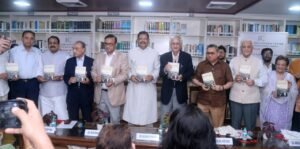
A series of major announcements and launches marked the event. Shri Puri unveiled the revised PNG Rules and MRSC, aimed at enhancing policy clarity, boosting investor confidence, and furthering Ease of Doing Business. He also announced the commencement of Hydrocarbon Resource Assessment Studies using globally benchmarked methodologies to better estimate India’s resource base. Key MoUs were exchanged during the conclave, including one between bp and ONGC for stratigraphic well studies to deepen understanding of India’s subsurface geology, and another between DGH and NIC to establish a cloud-based National Data Repository for transparent and centralised upstream data management. The Minister also released the India Hydrocarbon Outlook 2024–25, the 32nd edition of DGH’s flagship report, which provides data-driven insights for shaping future E\&P strategies and investment decisions.
As part of the conclave’s innovation showcase, Shri Puri visited the Exhibition Gallery and Innovation Center, which featured over 50 technical posters and more than 15 innovative solutions presented by E\&P operators, start-ups, and academic institutions. He interacted with several participants and acknowledged the importance of continuous technological innovation in shaping the future of India’s upstream industry.